Business schools teach frameworks. The best operators teach decisions. That gap — between the framework and the decision — is where almost every young CEO gets stuck, and it's where the difference between a good operator and a great one actually shows up.
I've been lucky enough to sit across the table from a lot of strong operators in my career. Some of them ran public companies. Some of them ran family businesses into their third generation. Some ran restaurants, some ran casinos, some ran defense contractors. What I noticed over time is that the really good ones — the ones I still think about years later — almost never talk in frameworks. They talk in decisions. Specific ones. With dates attached.
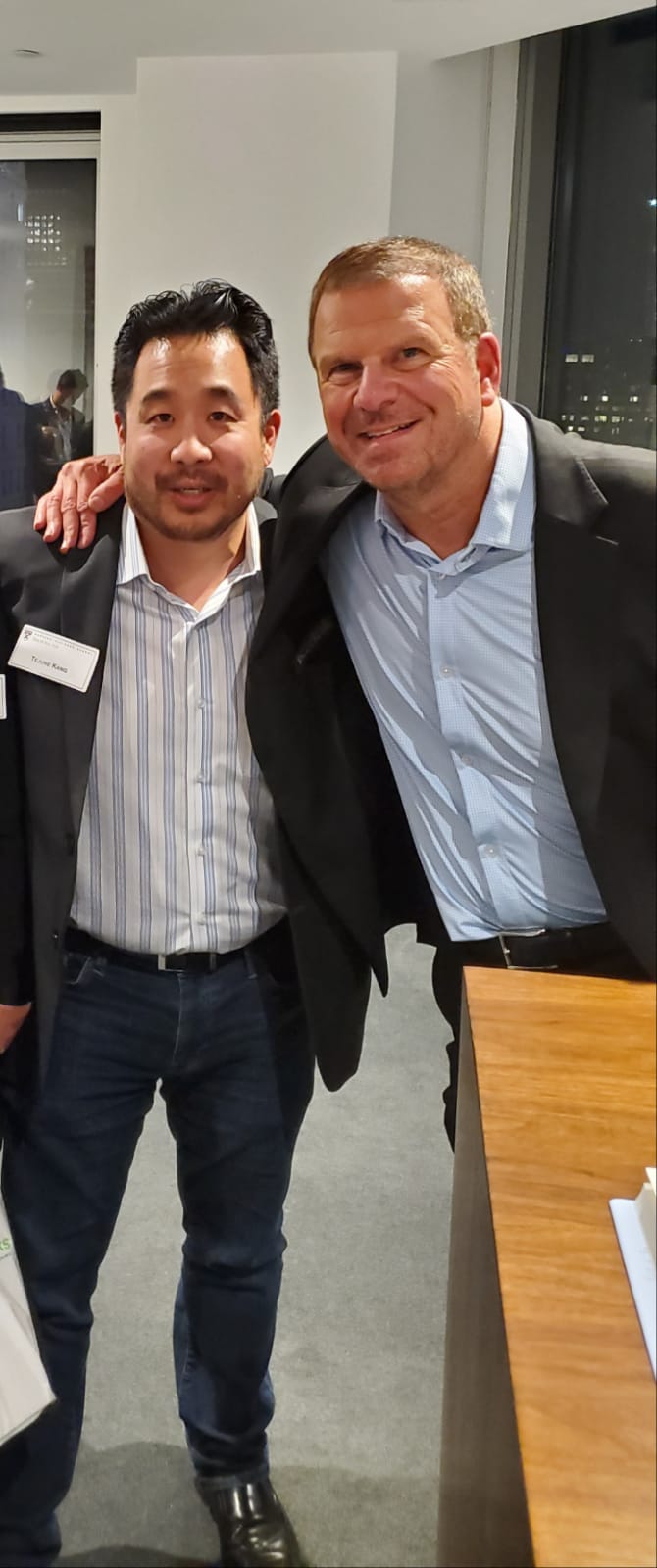
Nowhere did I see that clearer than the night I sat in on a conversation with Tilman Fertitta at the Harvard Club in New York, around the time he was out promoting his book Shut Up and Listen! For those who don't know him, Tilman is the sole owner of Landry's — that's 600+ restaurants, Golden Nugget Casinos, plus he owns the Houston Rockets. He built it himself. No partners. No PE. No outside capital on the core business. Just 40 years of relentless practical operating. His book is on Amazon if you want the full version — I recommend it to any operator I advise.
He didn't talk in frameworks. He talked in stories.
Here is what I noticed immediately. Tilman didn't use the words "strategy," "synergy," "optimization," or "scale." Not once, in the entire conversation, did he reach for an MBA noun. He told stories. Specific ones. "I bought that building in 1994 for $X. The guy thought he was clever. Here's what he missed." "I was running the grill myself at my first restaurant. We lost $800 that night. Here's what I changed on Tuesday."
The stories were surgical. You could feel that each one had been lived through, not studied. He wasn't generalizing — he was remembering. And somewhere about halfway through the evening it clicked for me: this is what practical operating actually sounds like.
Practical operators don't tell you what to think. They tell you what they did. Then they let the pattern land.
Every young CEO I talk to today is soaked in frameworks. OKRs, SPIFs, V2MOMs, North Stars, Vision Pyramids, BHAGs. The frameworks aren't wrong. They're just not the job. The job is making the decision at 7pm on Tuesday when the numbers don't match, the sales lead is threatening to quit, and your key engineer's wife is in the hospital. No framework gets you through that. Pattern recognition does. And pattern recognition only comes from stories — either ones you lived or ones you absorbed from operators who did.
What I walked away with
I don't want to give you a 12-point list. That would be exactly the thing Tilman would make fun of. Let me give you four things instead, because they're the four I've actually used since that night.
1. Own the thing. Don't rent it.
Tilman said something I'll never forget about real estate: "If you're going to be in the restaurant business for 40 years, you'd better own the building." He'd watched too many operators pay rent forever and wake up at 65 with nothing. The underlying principle isn't about real estate — it's about ownership of the asset that compounds. For me, in enterprise tech, that was always the customer relationship and the data. Other people can rent those. Operators own them.
2. Hospitality is a margin strategy, not a soft skill
Most people think hospitality is about being nice. Tilman made it clear: hospitality is about economics. If your guest has a great experience, they come back. If they come back, your customer acquisition cost goes to zero. If your CAC goes to zero, your margin profile is transformed. The soft stuff is the hardest economic stuff. I've seen this play out in B2B services, in marketplaces, in digital transformation consulting — and now I watch it play out on the B2B beauty side of my current business. The brands that win their buyers' loyalty aren't the cheapest. They're the warmest.
3. The numbers are either in your head by Tuesday or you don't run the business
This is the one that changed how I run every Monday meeting. Tilman told a story about how, in the early days, he personally knew the gross sales of every restaurant every single day. Not because he was a control freak. Because he couldn't afford to find out on Thursday that something was broken on Monday. He had to know Monday night. If the numbers aren't in your head within 24 hours, you're always one week behind the problem — and one week behind in operations is often the difference between a good quarter and a bad one.
4. Brutal honesty is kinder than fake optimism
The whole premise of his book is in the title. Shut Up and Listen. The part people miss is that listening isn't passive. Listening is about letting the real answer land — even if the real answer is "this is broken, we're losing money, and we need to fix it now." Fake optimism is how companies die slowly. Real honesty, delivered without drama, is how they survive.
The Harvard Club irony
Here's the part that made me smile. We were in the Harvard Club. A room full of Harvard credentials, Harvard ties, Harvard portraits on the walls. And the most Harvard-relevant lesson of the night came from a guy who didn't need the Harvard framework to build a multi-billion-dollar operating empire. He needed the decisions. The stories. The Tuesday-night muscle memory of running a grill himself.
I went to Harvard Business School OPM 50. I value what I learned there. But I value what I learned from operators like Tilman more — because the classroom teaches you what should work. The operator teaches you what does work when everyone in the room is tired, the number is worse than you thought, and you still have to make the call.
Your challenge
If you're running a company right now, here is what I want you to do this week. Cancel one recurring strategy meeting. Just one. In its place, book a 60-minute conversation with an operator who runs a real business — not a consultant, not a board member, not an author. An operator. Ask them exactly two questions:
- "What is one decision you made in the last 30 days that you'll remember five years from now?"
- "What did you learn the hard way that you wish someone had told you in your first year?"
Then shut up and listen. Write it down. Read it back on Sunday night. Do it every month for a year. At the end of that year you will know more about running your business than a full Executive MBA would teach you, and you will know it from the inside — the way Tilman knew his gross sales on a Monday night in 1985.
That is practical operating. That is the thing no framework teaches. That is the thing I am still learning at 31 years in, and the thing I'll be learning when I'm 70. The best operators never graduate. They just collect more decisions.